 STRATAGEM LABS


Executive summary
AI spending can exceed its recognized budget when charges sit in other cost categories or consumption grows continuously. The article distinguishes misattributed stock costs from usage-driven flow costs and argues for visibility, ownership and continuous governance.
"Kiran, I have signed off on every AI line item on my sheet, and I still could not tell you what we actually spend."
A finance leader I have known for a while said that to me on the phone recently, a little perturbed - in the way only a person who prides themselves on their numbers can be. They had just discovered the company was spending close to double what the budget showed on artificial intelligence (AI), the hidden half simply sitting where no one was looking. No lie, no fraud, no fireable carelessness. I have thought about that sentence a lot since.
It is, I think, the quiet anxiety of a great many finance leaders right now, and most have not yet said it out loud.
Consider one small sign of the moment. This June, Ramp - a corporate spend-management company - raised money at a forty-four-billion-dollar valuation. That number reflects a large, serious financial-operations platform, not any single feature. But one of the products it has been building lately is worth noticing on its own terms: a tool that maps how much a company is actually spending on AI, tokens and all. Ramp's own framing stayed with me - that the danger is not spending, but blind spending.
When a serious company decides that helping finance leaders simply see their AI costs is worth a product, those costs had clearly become hard to see in the first place.
Here is the thing I keep coming back to. Finance has managed expensive before. Expensive is not new. A factory is expensive. An acquisition is expensive. We have a century of accumulated wisdom for expensive, and it works beautifully. The problem with AI is not that it is expensive - the problem is that it is expensive in a way our existing tools were never built to see.
Two shapes of AI spending
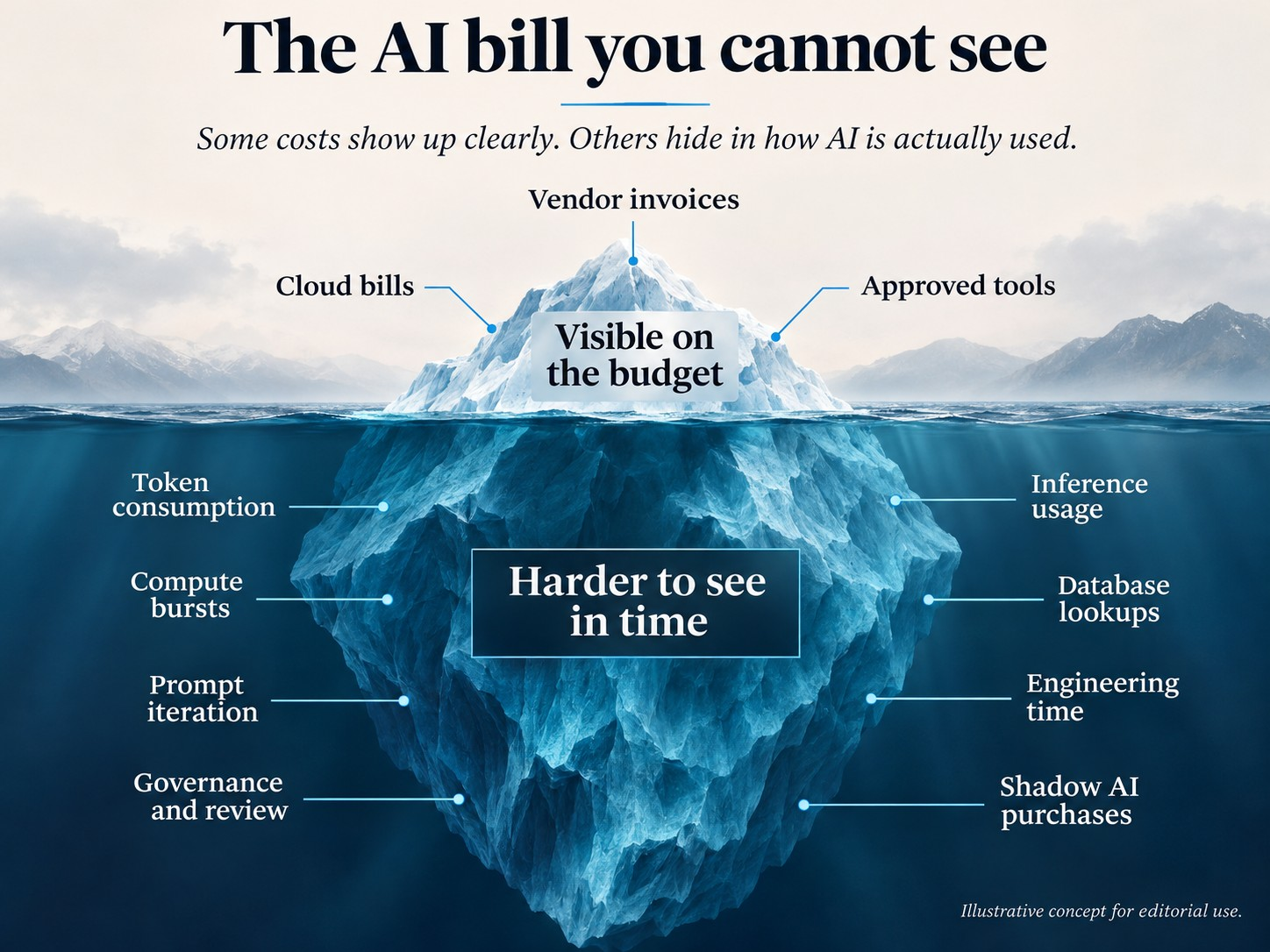
I have found it helpful to think of AI money as arriving in two shapes. One I would call stock - costs simply in the wrong place. A cloud line that is really AI. A "customer insights platform" that is a machine-learning model wearing a marketing name. A data engineer whose salary sits in one budget while forty percent of her week goes to an AI project. This money is not moving, it is merely misfiled - and misfiled money you can find. You audit once, you reallocate, and it stays found.
The other shape is harder, and it is the one that breaks budgets. I think of it as flow - live meters running right now, as you read this. Tokens consumed per request. Compute hours consumed behind every workload. Database lookups triggered behind a single innocent question. You reconcile last month's invoice, and by the time you have, the meter has moved on. You cannot audit flow into submission, because it does not sit still long enough to be audited.
It has to be governed, continuously, or it is not governed at all. (Auditing your flow costs, I have taken to saying, is like photographing a river and then acting surprised the water kept moving.)
And here is what changed, and why this matters now and not three years ago. When AI meant a handful of licensed tools and a small data-science team, almost all the hidden money was stock - misplaced but stable, and a decent audit caught it. As organizations moved from pilots to production, and from chatbots to agents that plan and act on their own, the cost they were least equipped to govern increasingly became flow. Variable. Usage-priced. Moving faster than any budget cycle can follow.
Stock
Known expenses allocated to the wrong budget or category.
Find the AI portion, then classify it correctly.
Flow
Token usage, compute and lookups accumulating with every workload.
Measure and govern consumption continuously.
Where the cost is missed
Let me be specific about where the money hides. It hides in the cloud bill, where AI workloads wear the same clothes as everything else and nothing was tagged. It hides inside vendor invoices, where a business unit bought "predictive analytics" or "conversation intelligence" and finance saw the vendor's name, not the AI engine underneath.
It hides in what many now call shadow AI - the developer's model key on a personal card, the marketing team's content generator, the analyst's research assistant - each charge small enough to survive, all of them together adding up to real money. And it hides, most of all, in people: the data engineers, security reviewers, compliance officers, and subject-matter experts who quietly spend a meaningful slice of their week on an AI initiative that lives in someone else's budget.
Run all of that down honestly and many organizations discover a material gap between the AI budget they recognized and the AI cost they were actually carrying. That gap is not an accounting embarrassment - it is a strategic blind spot. You cannot have been making deliberate decisions about money you did not know you were spending, and, the part that should give any of us pause, you cannot have been calculating your return on AI correctly when part of the denominator was simply invisible.
 View full-size illustration (opens in a new tab)
Why governance must follow usage
I do not want to leave you gloomy, though, because the story is more hopeful than the panic suggests. Consider Uber earlier this year. It rolled agentic coding assistants across its engineering organization, usage doubled in a single quarter, and it had effectively exhausted its full-year budget for AI coding tools by April - four months in. Its CTO said he was "back to the drawing board." And yet nothing malfunctioned. The tool worked exactly as intended.
The business case had been built on the economics of a chatbot and paid at the scale of an agent, and the difference between those two is where the budget disappeared. Tellingly, Uber's response was not to abandon the tools but to govern them - caps, cheaper models for routine work, plain cost awareness.
Notice what that story is not. It is not about AI being too expensive to bother with. For a great deal of everyday AI work, the per-unit price has genuinely collapsed - faster than almost anything I can remember in computing. (Not uniformly, I should say: frontier capability can still command a significant premium, and some of today's cheap pricing may not persist.
"AI is getting cheaper" is true for the floor and false for the ceiling.) But for the workloads most companies run, the bill climbs not because the technology is costly. It climbs because the consumption is ungoverned. Which is oddly wonderful news, because governance is precisely what finance knows how to do. The falling price is on your side - if, and only if, you govern the volume.
So the answer to a runaway AI bill was never "use less AI." It is the answer finance has always given to money that behaves badly: see it, own it, and put discipline around it before it commits, not after. The tools need to change. The instinct does not.
I will end where I began, with my friend on the phone. What unsettled them was not the size of the number. It was that they could not see it. And I have come to believe that visibility - plain, unglamorous visibility - is the first and most valuable act of financial leadership in the age of AI. Everything else follows from it.
If you are a finance leader reading this, I would genuinely love to know: have you gone looking for the AI spend hiding on your own books yet? And if you did, did the number surprise you? I have a feeling I am not the only one collecting these stories. Thank you, as always, for reading, and do share your perspective.
Editorial note: All 20 paragraphs above are reproduced in their original order. The summary, headings, takeaways and illustrations are additions for this website edition.