 STRATAGEM LABS

Executive summary
A lower price per token can coexist with a higher AI bill when consumption grows faster than unit prices fall. Using a wholesale-store trolley as the analogy, the article shifts attention from purchase price and build cost to usage, recurring run rate and the cost of operating at production volume.
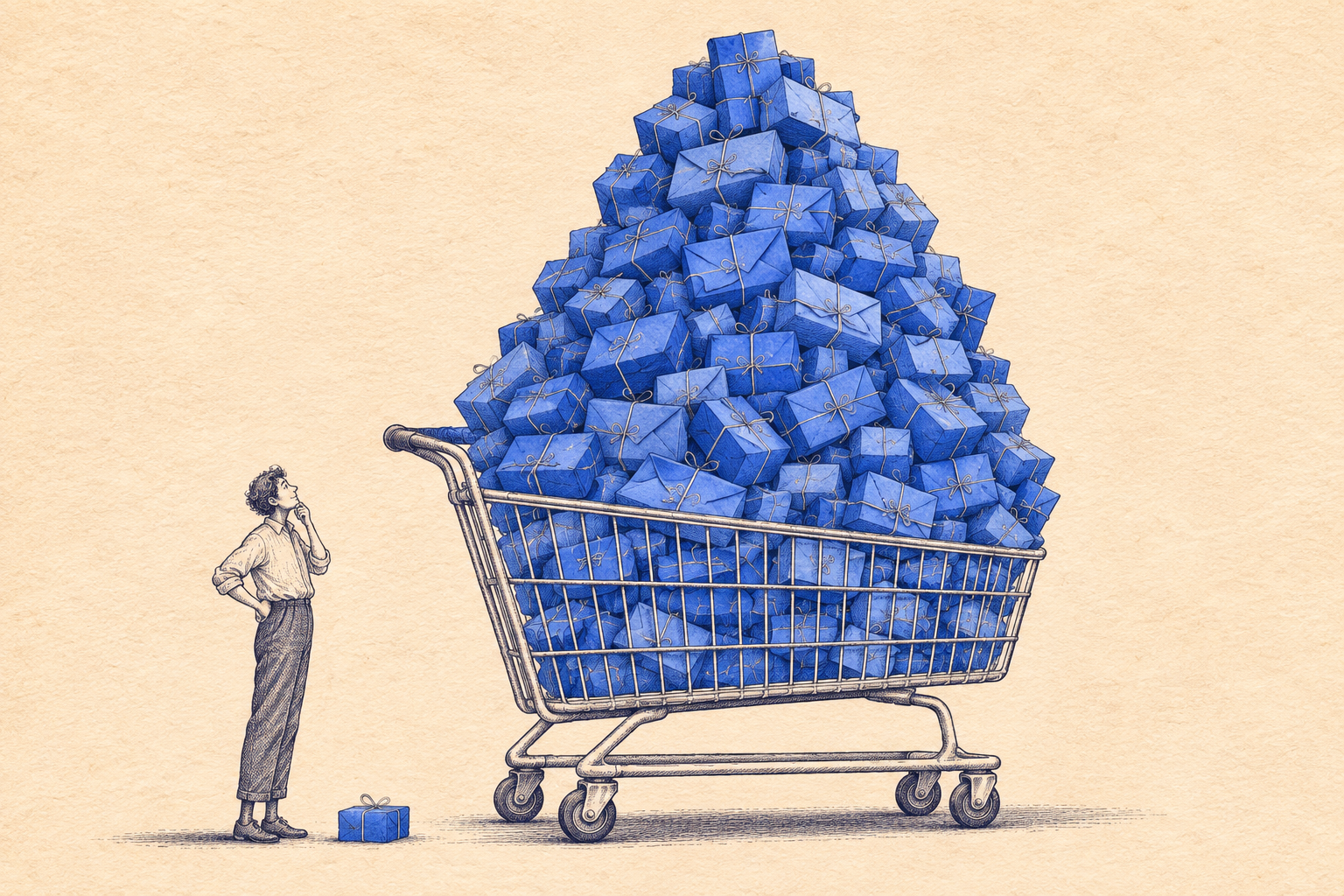
The wholesale trolley
The last time I went to one of those giant wholesale stores, the kind where everything comes in a pack of forty-eight, I did a small, slightly embarrassing thing at the billing counter. I looked at the total, then looked at the trolley, and quietly wondered how a trip built entirely around saving money had cost me so much of it. Even as I say this, why do I feel most of you can relate to this and although I make it sound it happened with me once, it actually happened more than once. Anyway...
Every single item was cheaper per unit than at my neighbourhood shop. That was the whole point of going. The rice cheaper by the kilo, the coffee cheaper by the gram, the dish soap cheaper by the litre. I had not been careless. I had, item by item, made the thrifty choice every time. And I still walked out having spent more than I ever do at the regular store, because cheaper per unit is exactly what talked me into filling the trolley. (Who buys one toothbrush when six cost almost the same? Not me, apparently.)
I have been thinking about that trolley a lot, because it is the best explanation I have found for a number that a lot of finance leaders are quietly puzzling over right now. The price of AI tokens has collapsed. The AI bill has gone up. Both of those are true at the same time, and the wholesale trolley is why.
Cheaper units, larger bills
Start with the collapse, because it is real and genuinely wonderful. Stanford's AI Index found that running a model at the quality of GPT-3.5, the one that stunned everyone in late 2022, fell from around twenty dollars per million tokens to about seven cents by late 2024. That is a drop of more than 280 times in roughly two years, one of the steepest price declines in the history of computing. Nothing about that is bad news. The same intelligence that cost a small fortune a couple of years ago now costs a rounding error.
And yet the bills went up, not down. One 2026 industry index found that spending on AI-native software grew 108 percent in a year, more than doubling, with 78 percent of technology leaders reporting charges they had never budgeted for. So the unit price fell through the floor and the total at the bottom of the invoice climbed anyway. If that feels like it should be impossible, you are feeling exactly what I felt at that billing counter.
The reconciliation is the whole lesson, and it is not complicated. Usage grew faster than price fell. When something becomes dramatically cheaper, almost nobody uses the same amount and pockets the savings. They use far more of it. Every team finds a use for the model, every use runs more queries, each query costs a sliver of what it used to, and the number at the bottom of the invoice gets bigger, not smaller. The cheapness does not get banked. It gets spent, and then some. (Economists have had a name for this since someone noticed it about coal in the 1860s, but you do not need the name. You have the trolley.)
From build cost to run rate
Here is why this matters to whoever signs the checks, and it is really a shift in where you point your attention. For years the expensive part of AI was building the thing: training the model, standing up the infrastructure, hiring the rare people. That is the mental model a lot of finance leaders still carry, a big upfront project you fund once and depreciate, like a system rollout. It has quietly stopped being true. The expensive part now is running the thing, the compute spent every single time it answers, every hour it is live, indefinitely. And that cost does not sit still. It moves with usage.
So the number that should anchor an AI decision is no longer the build cost. It is the run rate, at volume, carried forward. The question that matters is not what will it cost to build this. It is what does this bill become when ten thousand people use it every day, and then a hundred thousand. A model that looks comfortably profitable in a pilot can turn into a quiet loss in production, not because anything broke, but because the run count grew in a shape nobody drew on the whiteboard. The pilot was the corner shop. Production is the wholesale trolley.
Watch the usage curve
That hands you a simple instrument, and it fits on one line. Total spend equals price per unit times usage. Two terms. For two years everyone has been mesmerized by the first one falling, and it is going to keep falling, which feels like good news and mostly is. But the second term, usage, is the one that runs. It is the one that compounds. So the discipline is almost rude in how simple it is: stop watching the price tag, and start watching the usage curve. Ask the team not what a thousand tokens cost today, but how many thousands you will be buying a year from now, and whether anyone has actually drawn that line or just assumed it stays flat.
The honest answer is that it will not stay flat. Goldman Sachs Research recently projected that token demand could grow roughly twenty-four times by 2030. Whatever the exact multiple turns out to be, the direction is not in question. Prices will keep sliding, which will keep tempting everyone to treat AI as a line item that looks after itself. Meanwhile the volume underneath will keep climbing, quietly, and the bill will follow the volume, not the price. Budget off the falling price and you will be surprised every quarter. Budget off the rising usage and you will not.
Spend with your eyes open
None of this is an argument against AI, and I want to be careful here, because the cheapness is a gift. The collapse in price is what lets a small team try something that would have been unthinkable three years ago, and most of that experimenting is healthy and worth every rupee or dollar. The point is not to spend less. The point is to spend with your eyes open, to know that you are standing in the wholesale store, and to decide on purpose how much goes into the trolley rather than finding out at the counter.
So the next time someone tells you the per-token price just dropped again, by all means be glad. Then ask the one question that actually tells you what next year costs. Not how far the price fell, but how much more you are about to use. What does the bill look like at ten times today's usage? At a hundred? Has anyone drawn that curve?
I would love to know whether the AI bills you are seeing have behaved like my trolley. I have a feeling that, for most of you, they have.
Original sources
Sources:
Stanford HAI, AI Index Report 2025 (inference at GPT-3.5-level quality fell from about $20 to about $0.07 per million tokens, November 2022 to October 2024, a drop of more than 280x), reported by Silicon Canals, July 6, 2026: https://siliconcanals.com/the-cost-of-running-a-top-tier-ai-query-dropped-280-fold-in-roughly-18-months-from-20-per-million-tokens-in-late-2022-to-seven-cents-by-late-2024-a-price-collapse-with-no-real-parallel-in/
Zylo, 2026 SaaS Management Index (AI-native application spend up 108 percent year over year; 78 percent of IT leaders reported unexpected charges tied to consumption-based or AI pricing), January 29, 2026: https://zylo.com/news/2026-saas-management-index
Goldman Sachs Research (global token consumption projected to grow about 24 times by 2030), reported by Digital Citizen, May 9, 2026: https://www.digitalcitizen.life/goldman-sachs-expects-agentic-ai-to-drive-a-huge-jump-in-token-use-by-2030/
#CFO #FinOps #EnterpriseAI #AICostManagement #TokenEconomics
Editorial note: The original article wording and sequence are preserved. The executive summary, section headings, takeaways and cover illustration are editorial additions.