 STRATAGEM LABS


Executive summary
Reasoning models introduce variability into the cost of each request because the amount of internal computation can change after submission. The article argues that finance teams should examine the spread of task costs, not just averages, and make deliberate choices about reasoning budgets.
Years ago, in a city I was visiting for work, I hailed an auto rickshaw (for the unversed an auto rickshaw is most often a three seater, three wheeler cab very common in India) the way you do when you are new and slightly lost - quickly, and without asking the one question I should have asked first. The meter, it turned out, was more of a suggestion. Somewhere between the hotel and the office the driver made a series of small decisions I never saw: a longer route because of a procession, a wait at a level crossing, a judgment about how much effort this particular trip deserved. I did not learn the fare until we arrived. I had agreed to the ride. I had not, in any meaningful sense, agreed to the price, because the price hadn't been decided when I got in. It was decided along the way, by someone who was not me.
I have been thinking about that little ride (and many such rides I had taken) a great deal lately, because I have come to believe it is the most honest picture I have of what just changed in the economics of AI. And I say this gently, because I am fairly sure I am about to state something many of you have already felt in your own invoices.
The price changes after you commit
For the entire history of software - and I do mean the entire history - the thing you bought had a price you could know before you bought it. A licence was a licence. A seat was a seat. Even the move to the cloud, which unsettled so much, kept that one comfort intact: usage went up and down, but a given action had a knowable unit cost. You could point at a thing and say what it costs. That single, quiet assumption is the one the newest models have broken, and I am not sure we have collectively sat with how strange the break is.
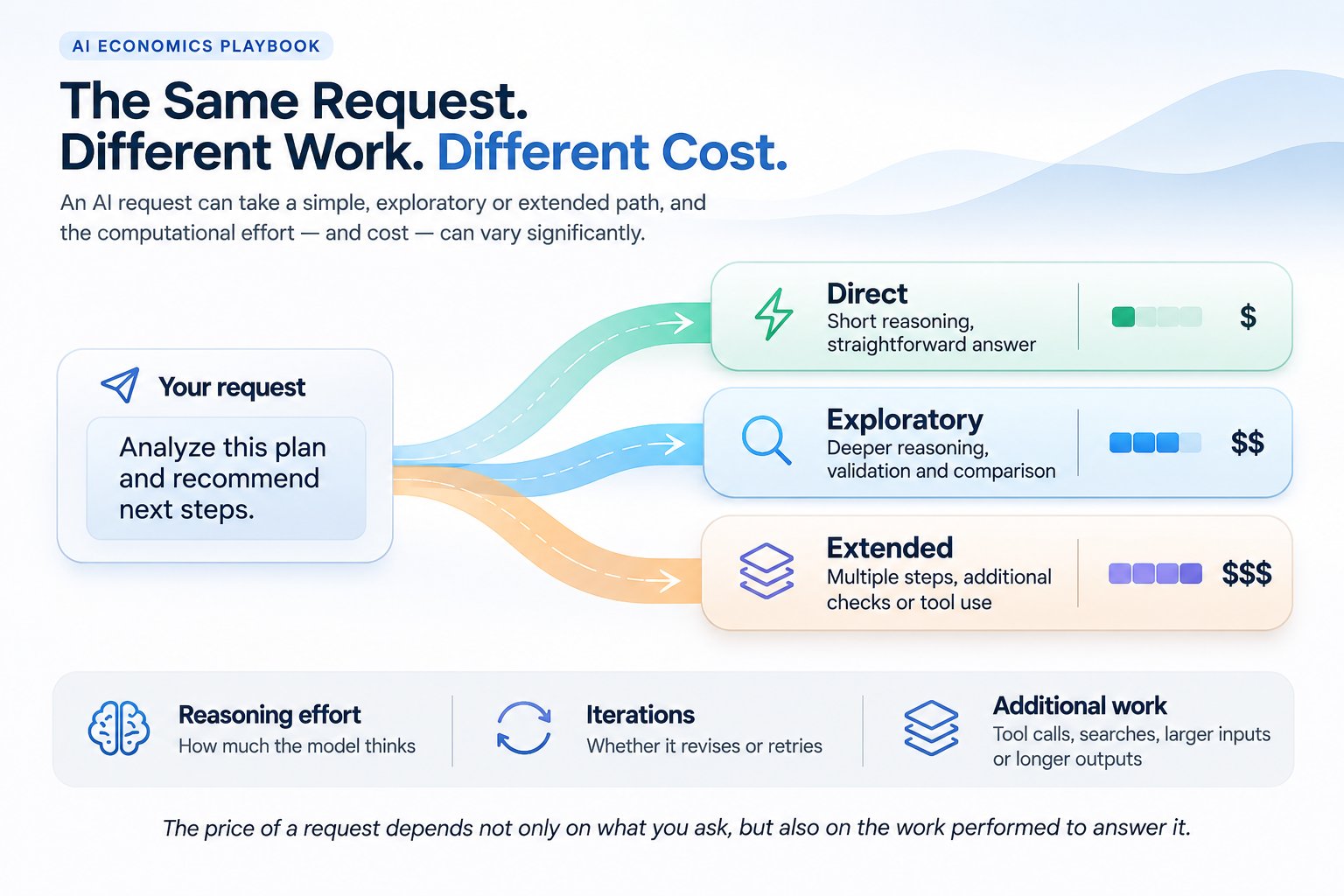
Here is the mechanism, stripped of the mystique. The latest reasoning models do not answer you immediately. They think first - they work through the problem internally before they respond - and, crucially, they decide for themselves how long to think based on how hard the problem looks to them once they see it. The thinking is genuinely valuable; it is what makes these models good at difficult work. But notice what it does to the money. The model chooses how much to spend after it sees your request, which means the cost of a request is no longer something you can read off the request. You hit send. Then the software decides how much of your budget this one is worth.
That is the auto rickshaw, precisely. You commit to the ride, and the fare is set along the way, by something that is not you.
 View full-size illustration (opens in a new tab)
The cost is a range, not a fixed number
I want to be careful and not dramatic here, so let me ground it in what people are actually reporting this year rather than in my own alarm. Practitioners have started describing reasoning-token costs, quite openly, as a "black box." In one trade account this July, the CFO of a well-known enterprise software firm used exactly that phrase; an academic quoted in the same piece said that once reasoning tokens entered his workloads, the bill became, in his word, essentially random - a large and often hidden share of the total that he could not predict in advance. The concrete numbers are milder than the horror stories but make the same point: an answer that shows you five hundred tokens can quietly carry two to three thousand billed once the invisible thinking is counted, and heavier analysis lands many times higher still. On frontier models, the book I have been writing puts a single deliberation at up to an order of magnitude or more of the compute of a plain answer - and I would treat even that as a moving figure, not a fixed one. Run the same prompt twice and it may think for very different lengths. Your unit cost is no longer a number. It is a distribution.
There is even a documented failure mode, which I find almost poignant - it is politely called overthinking - where the model spends more of your money to arrive at a slightly worse answer. I mention it not to score a point but because it is such a clean illustration of the problem: more spend is not always more value, and when the spender is the software, the two can quietly come apart.
Now, if the story ended there it would just be a complaint, and I try not to write complaints. So here is the part that actually matters, and it is genuinely hopeful.
A small lever with financial consequences
The labs, to their real credit, have handed us the instrument to govern this. It has an unglamorous name - a thinking budget, or on some platforms a reasoning-effort setting - and it is simply an explicit cap on how much the model is allowed to deliberate before it must answer. Left unset, the model spends at its own discretion, which is the default most teams are quietly running on right now. Set deliberately, you are the one who decides how much a given task's thinking is worth paying for. A routine classification does not need the model to agonize. A genuinely hard, high-stakes judgment might. The point is that the choice becomes yours again.
And this is where I think it stops being an engineering detail and becomes, squarely, a finance question. Because a finance leader who does not know that lever exists is, without ever choosing to, delegating a spending decision to a piece of software - the way I delegated my fare to a driver I had never met. One who insists the lever gets set, and set on purpose, has quietly reclaimed a decision that was always supposed to be theirs. Nothing more dramatic than that. No new framework, no new committee. Just the old, unglamorous discipline of refusing to let a cost be decided by someone who does not answer for the budget.
I do not want to overstate my own certainty here - this is all very new, and I am learning it in more or less real time alongside everyone reading this. But if I had to compress it into one practical shift, it would be this. Stop asking your teams "what does this cost per token," which is last year's question, and start asking two newer ones: what is the range of what a typical task costs us, run again and again - not the average, the spread - and have we set a thinking budget, deliberately, or are we running on the model's discretion by default? The first question turns a number into a distribution, which is the honest shape of it now. The second turns a silent delegation back into a decision.
None of this is a reason to be afraid of reasoning models. They are extraordinary, and the thinking is exactly why. It is only a reason to notice that a very old assumption - that you know the price before you commit - has quietly stopped being true, and to pick up the small, boring lever that hands the decision back to you. The technology moved. The discipline is the same discipline it has always been. It just has one more place to stand.
I would love to hear from those of you closer to this than I am. Have you set thinking budgets in production, and did it change your bill in a way you could see? Or have you been surprised at the end of a ride you thought you understood the price of? Always ready for a learning or two.
Thank you for reading.
Sources: reasoning-token cost described as a "black box," with unpredictable bills — AI Business, "As AI Spending Climbs, Enterprises Get Serious About Token Costs" (July 2026). Illustrative token figures: Tian Pan, "Reasoning-Effort Budgeting" (April 2026). The cost mechanics, the "overthinking" effect, and the thinking-budget lever draw on my forthcoming book, The AI Economics Playbook.
#CFO #FinOps #EnterpriseAI #TokenEconomics
Editorial note: The original article body, source notes and hashtags are retained. The executive summary, section headings, takeaways and the conceptual diagram are website additions.