 STRATAGEM LABS


Executive summary
An AI investment pitch can look credible on paper while leaving its most consequential risks unanswered. The practical response is to require evidence of a smaller proof, business accountability, operating economics, resilience, and pre-agreed stopping conditions.
Someone comes to you with a number. They need seven hundred and fifty thousand dollars to build an AI system, the manual way of doing it is bleeding roughly four million a year, and this will cut that by more than half. Nine months to deploy. The team is ready. It is a good pitch. It has a quantified problem, a quantified benefit, a timeline, and people who say go. On paper it clears every bar.
And it is precisely because it clears every bar on paper that it should make you a little uneasy, because none of the bars it clears are the ones that decide whether an AI project lives or dies.
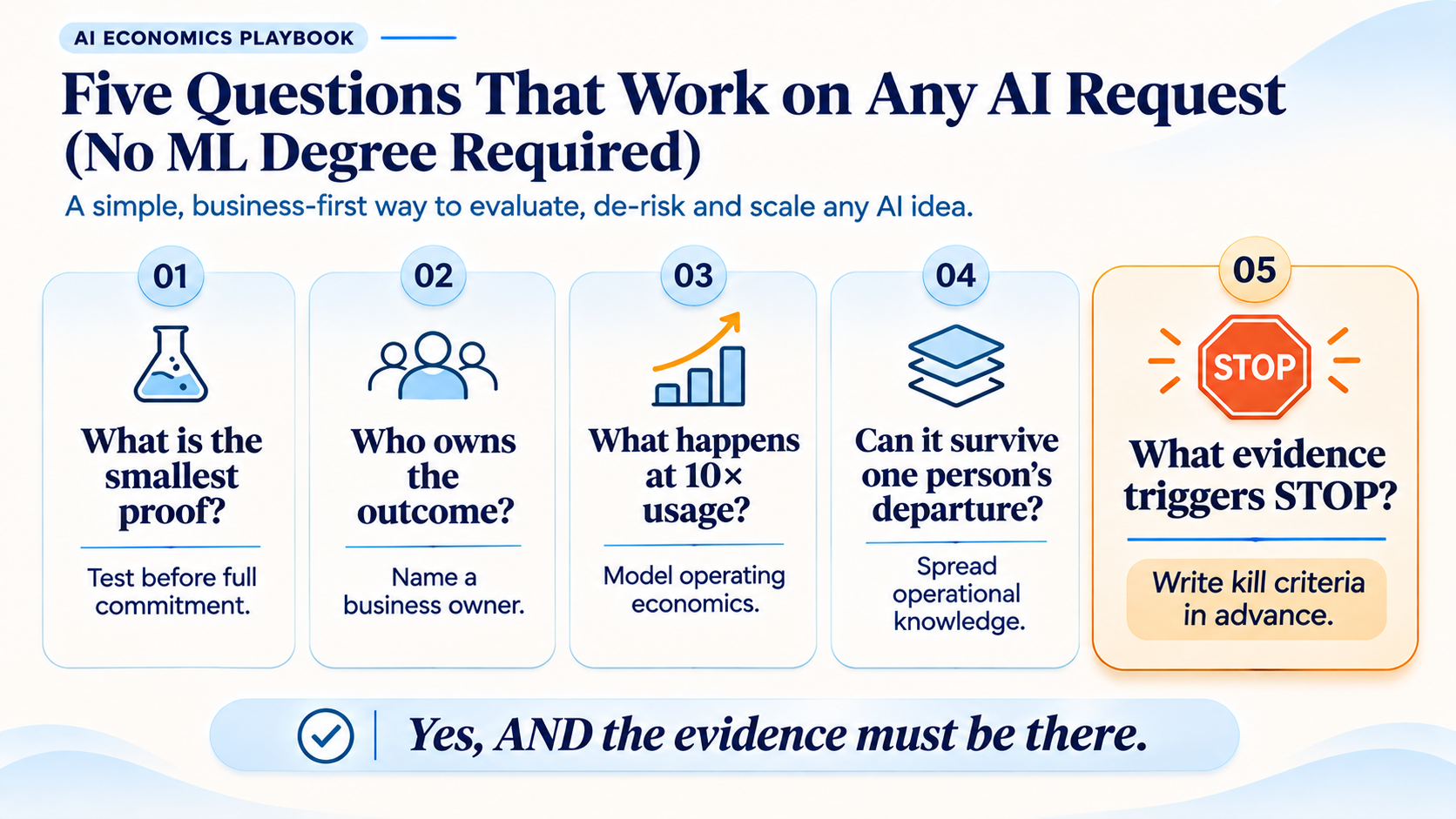
Here is what I have learned from watching a fair number of these requests get approved and then watching where the money actually went. It rarely leaves through the thing everyone argued about in the room. It leaves quietly, months later, through the questions nobody thought to ask. And the questions that would have caught it are not the hard ones. They are plain questions about money, about who is accountable, and about when to stop, the kind you can put to the most sophisticated AI team in the world without knowing the first thing about how the model works. Five of them do most of the work.
 View the illustration at full size
The smallest proof
What is the smallest version of this that would prove it works? The full nine-month build is an answer to a question you have not asked yet, which is whether the idea works at all. A serious request can describe a far smaller version, at a fraction of the cost, that would settle the core doubt before you commit to the rest. If the only version on offer is the whole thing, you are not being asked to fund a test. You are being asked to fund a conviction, and to find out whether it was the right one only after the money is spent.
Ownership of the business result
Who owns the business result, and not just the model? Ask for a name, and make sure the name belongs to someone in the operation, not on the AI team. Not who builds it, who is on the hook for the number it was meant to move. This is the question most requests are quietly built to avoid, because it shifts the ground from "we shipped what was asked" to "we changed what we promised to change." If nobody in the business will put their name against the outcome, you are not funding a business initiative. You are funding a science project, and it should be priced as one.
Economics at scale
What does this cost at ten times the use? An AI system's real cost is often not the build at all, it is what it takes to keep running it, and that running cost moves with usage in ways the build budget never shows you. A system that is comfortably profitable at a thousand uses a day can look very different at a hundred thousand once inference, infrastructure, monitoring, support, and human review are properly counted. A credible answer draws that curve, at one, ten, and a hundred times today's volume, and shows where the economics still hold and where they quietly invert. A request that has not drawn the curve does not yet know whether it is proposing a profit or a loss, and neither do you.
Operational resilience
What happens the day the person who understands this leaves? A surprising number of AI systems have what engineers call a bus factor of one, a single person who is the only one who truly knows how the thing works. The day they walk out, it becomes a black box you cannot maintain, and you find that out at the worst possible moment. And the dependency shows up as money soon enough, in slower changes, expensive outside help, downtime, and a system nobody is confident enough to touch. The teams worth funding have a deliberate plan to spread the knowledge, document it, put more than one person in a position to run and repair the thing, and budget for that rather than hoping it sorts itself out. A lone hero named with pride is not a strength to admire. It is a risk you have not yet priced.
Evidence for stopping
When, and on what evidence, do we agree to stop? This is the one a hollow request struggles to answer and a serious one is willing to answer, which is what makes it the cleanest question you have. Ask for the conditions, set in advance, under which the project agrees to die: the specific results, by the specific dates, that would mean stop. What you are really testing is whether the team can recommend its own project's end, or whether, when the moment comes, you will hear instead that after all this investment it would be a shame to stop now. That second sentence is the sunk-cost fallacy in a suit, and it is how projects become zombies, never quite working, never quite killed, drawing budget by sheer inertia. The freedom to stop is not the opposite of commitment. It is part of what you are paying for.
Notice what these five have in common. Not one of them asks how the model works. They ask who is accountable, what it truly costs, and when it ends, which are finance questions, the oldest ones you have, simply pointed at a newer kind of investment. I want to be careful here, because it would be easy to hear this as "the technology is the easy part." It is not. Building an AI system that genuinely works, and survives contact with the real world, is hard, with its own long list of ways to fail that have nothing to do with anyone in finance. But hard technology still runs on money. It needs funding to start, funding to sustain, and funding to grow, and each of those is a call someone has to make with incomplete information. That is why these questions matter, and why they matter not once, at the moment of approval, but as a regular cadence, because a project's economics drift as it scales and the honest answer in month one is rarely the honest answer in month twelve.
And while I have framed all of this around AI, very little of it is actually AI-specific. AI is hardly ever a project standing on its own; it rides inside a larger effort, tangled up with data, process, and people. These are simply the questions any serious investment deserves. AI has only made them louder, and a good deal harder to wave away.
One last thing, because the questions turn out to be the easy part. The hard part is holding the line when a request fails one of them, in a room full of talented people who mean well and would quite like you to let the missing answer slide until later. Later is precisely when your leverage is gone. The move is not to say no. It is to say yes, and then hold the line: yes, I can see the problem is real, and I need the kill criteria in writing before the money moves. The small word "and" is where the whole discipline lives, because it keeps the relationship warm while keeping the gate shut.
If you sit in these rooms, I would love to know which of the five your requests find hardest to answer. In my experience it is the last one, and it is the one that matters most. Do share your perspective, I am always ready for a learning or two.
#CFO #FinOps #EnterpriseAI #AIStrategy #AIGovernance
Editorial note: The original article wording and sequence are preserved. The executive summary, section headings, takeaways and illustration are editorial additions.