 STRATAGEM LABS


Executive summary
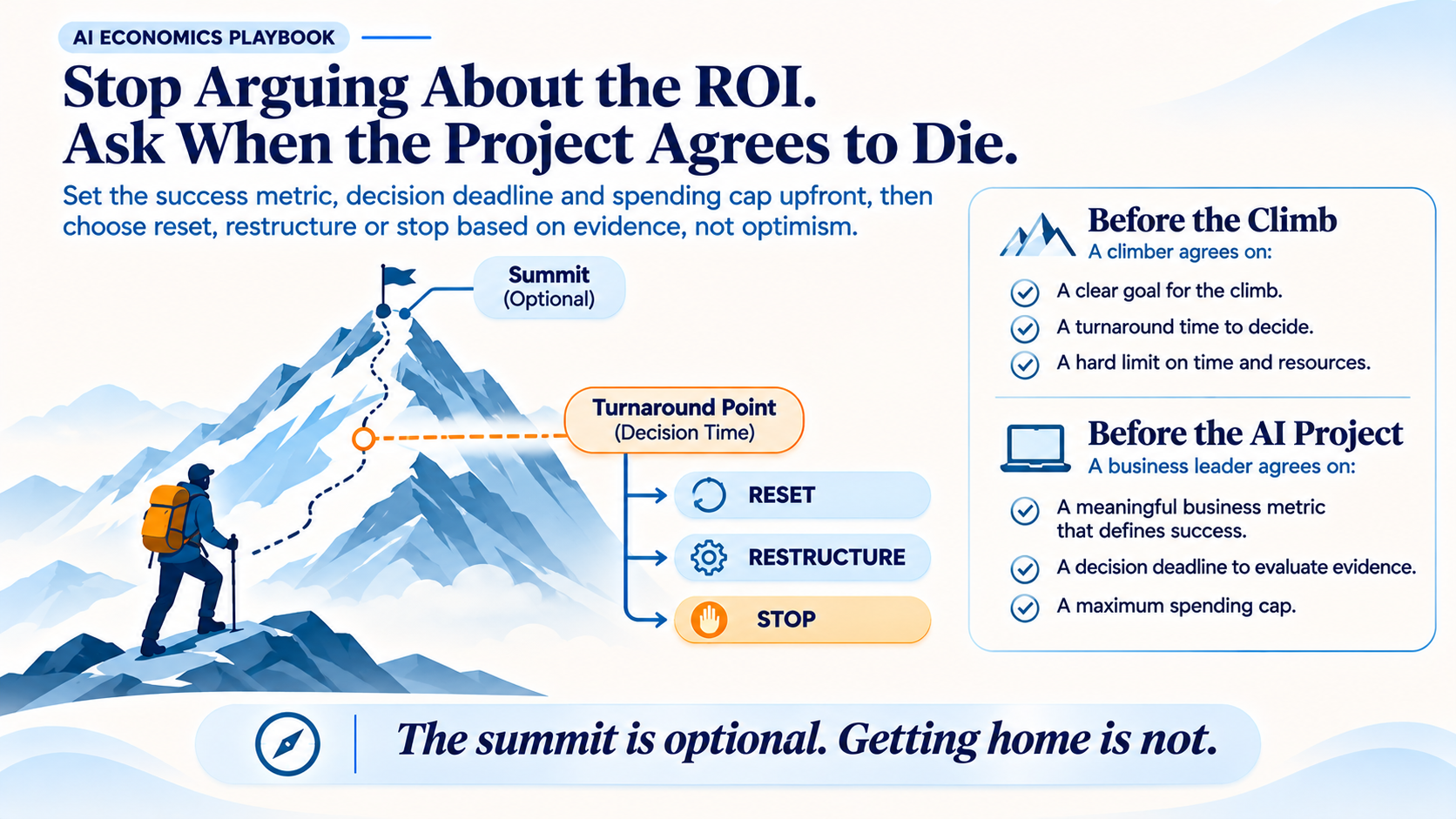
A climber agrees on a turnaround time before setting out. AI investment committees should apply the same discipline: specify a business success metric, an evidence deadline and a spending limit before funding a project. If those conditions are missed, decide whether to reset, restructure or stop, rather than arguing endlessly over forecast ROI.
There is a rule many serious climbers live by, and it has nothing to do with strength or nerve. Before the climb, while everyone is still warm and rested and thinking clearly, the team agrees on a turnaround time. Two in the afternoon, say. If you are not standing on the summit by two, you turn around, wherever you are, however close it looks, however much it has already cost you to get there. The summit is optional. Getting home is not.
The reason the rule exists is that the mountain is exactly the wrong place to make the decision. Near the top, tired, thin on oxygen, with the goal a heartbreaking few hundred metres away and a season of training behind you, no human being can be trusted to judge whether pressing on is worth it. So they do not. They make that one call earlier, in the calm, and then they simply keep the promise. The discipline is not in the climber's courage on the day. It is in the fact that the hardest decision was taken before the climb, by people who were not yet in love with the summit.
If you have read Jon Krakauer's Into Thin Air, his account of the 1996 Everest disaster, you know the rule can be set perfectly and still be broken: a turnaround time agreed in advance, and then, in the thin air near the summit, quietly let go, at a cost that is hard to read about. That is exactly why the discipline lives in the setting, not the moment. And I have been thinking about it a great deal lately while watching how organizations fund AI, because we tend to do almost precisely the opposite. We rarely even set the time.
 View the illustration at full size
The limits of a forecast
Sit in on a funding review for an AI project and you will see a lot of energy poured into a single question: is it worth it? The team brings a business case. The number at the bottom is impressive and, more tellingly, precise. Someone doubts the number. A better number is produced. The assumptions are debated, the discount rate is debated, the comparable is debated, and an hour later everyone is a little more tired and no one is any wiser, because the honest truth is that nobody in that room can know the return on a thing that has not been built yet. This early, the ROI is not a fact waiting to be discovered. It is a forecast wearing the costume of one.
And yet that is the argument we keep having, review after review. We argue about the summit. We almost never set the turnaround time.
Agree on stopping conditions
The move I would offer instead costs nothing but a change of question. Stop trying to settle whether the project will pay off. You cannot, not this early, and the debate mostly rewards whoever brought the most confident spreadsheet. Ask the team something they can actually answer: under what conditions would we stop this? Not "will it succeed," but "what would we have to see, and by when, to agree it has failed, and what would walking away cost us?"
That one question does more work than the entire ROI debate, and it is worth seeing why. Begin with the fact that it can be answered at all. Nobody can prove a future return, but any serious team can name the metric that would signal trouble, the date by which they would expect it to move, and the ceiling of spend beyond which the experiment stops being an experiment. If they cannot name those things, you have not hit a scheduling gap, you have your finding. A project that cannot describe the conditions of its own death has quietly decided it is never allowed to die, and every future setback will arrive already labelled as a reason to keep going.
What makes the question answerable is also what makes it honest. A projected return flatters everyone who signs off on it. A stated stopping condition does the reverse. It admits, out loud and in advance, that this might not work, which happens to be the truth about every real bet. Ask for it and the whole conversation changes character. You are no longer being sold a certainty, you are agreeing the terms of an uncertainty, which is a far healthier thing to be doing with other people's money.
And asking it early puts the hardest decision in the one place it can be made well. The climber's insight is that you cannot trust the judgement of the person near the summit, and the person twelve months into an AI project, with a team built around it and a reputation fastened to it and a great deal already spent, is standing exactly there. They are not weak and not dishonest. They are in the thin air with the goal in view, and asking them in that moment to weigh coldly whether to press on is asking for something almost nobody has. So you take the decision off the mountain and settle it in the calm, while everyone can still think.
A metric, a date and a spending cap
What does a real answer look like? It is unglamorous and short. A metric that matters, said in the language of the business rather than the model: not "accuracy improves" but "the support team resolves a set share of tickets without a human, or it does not." A date by which that metric should have moved, chosen so that missing it actually means something. And a number, a cap, beyond which you have agreed the exploration ends regardless of how promising it feels in the moment. Those three things, agreed before the money moves, are the turnaround time. They are worth more than any business case, because a business case tells you what someone hopes, and a stopping condition tells you what they are willing to be held to.
Reset, restructure or stop
None of this means the answer to a missed condition is always to shut the thing down. Stopping is one move, and often not the right one. You can reset, putting the criteria in place that should have been there from the start and letting the work go on under honest terms. You can restructure, taking something that has quietly swollen into an open-ended commitment and shrinking it back to a bounded bet with a real edge and a real end. Or you can stop, at the cost you already agreed, which is the entire reason you agreed it in advance. Collapsing all three into the single word "kill" is what makes finance leaders freeze, and freezing is the most expensive move of all.
Because the one thing that is never free is waiting. The cost of acting on a struggling project does not sit still while you deliberate. It climbs, and it climbs faster the longer the project has been someone's identity. A missing stopping rule fixed in the second month costs a short, slightly awkward conversation. The same gap found in the twelfth, after the headcount and the roadmap and the pride have all set hard around it, costs a political battle and a year of runway that could have funded better bets. I will not hang a multiplier on that, because the honest ones vary wildly and the slope is the point, not the figure. You already know the shape from every hard thing you have ever put off.
So the next time a room deadlocks over whether an AI project will pay off, I would gently suggest you are arguing about the summit, and that it is the wrong argument. Let the ROI number be roughly what it is, a hope held with appropriate humility. Spend your scrutiny instead on the question the team can answer and will be held to: when does this agree to die, and what does it cost us to let it? Get that in writing before anyone falls in love with the climb.
The reassuring part, and I do find it reassuring, is that this is not some exotic new skill invented for AI. Deciding in advance what you are and are not willing to lose is close to the oldest discipline in finance, older than any model on any slide. AI has only made it urgent again, because these projects hide their costs, stretch their timelines, and keep their promise shimmering just out of reach for longer than almost anything we have funded before. The mountain is new. The rule is not.
I am fairly sure I am restating something you already half knew, so I would love to hear how you actually handle this in your own reviews. Always ready for a learning or two.
#CFO #FinOps #EnterpriseAI #AIGovernance #AIROI
Editorial note: The original article wording and sequence are preserved. The executive summary, section headings, takeaways and illustration are editorial additions.