 STRATAGEM LABS


Executive summary
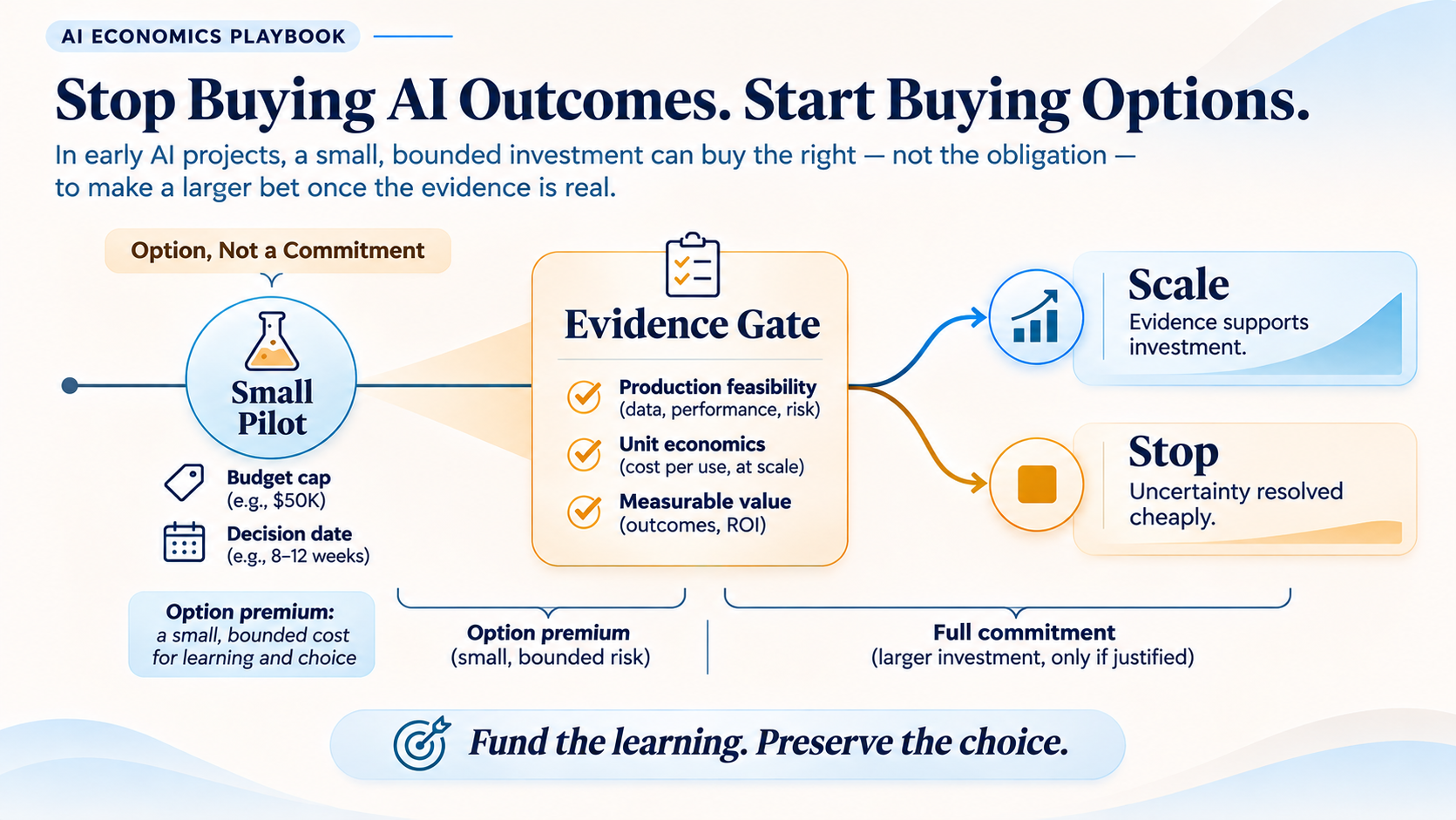
Early AI investments are best understood as options rather than promises of a fixed return. A small, time-bound pilot buys evidence and the right to scale later, while preserving the right to stop. Good portfolio governance makes unsuccessful experiments inexpensive and allows successful ones to grow.
A few years ago when I was in the US, I found an apartment I loved, and the leasing office asked for a small holding deposit - a few hundred dollars - to keep it off the market for a week while I made up my mind. I remember hesitating (I think mostly because at that instant, in my head, I could not figure out the tangible I was buying), and then putting in the deposit. Only later, while I was reminiscing, did I realize what I had actually bought. I had not bought the apartment. I had bought a week's worth of time. I had bought the right to decide later, once I knew a little more - whether the commute was bearable, whether the upstairs neighbour practised the drums, and a few other parameters - without the far larger cost of committing before I knew any of it.
So why this walk down memory lane? And how does any of it connect with the title? Well, let us see.
The pressure on finance teams to prove that their AI spending pays for itself has become intense - a July 2026 survey of roughly fifteen hundred senior finance leaders found that ninety-two percent feel it directly, and half said their AI agents had produced only limited measurable return so far. Nearly everyone is being asked for the number, and nearly half cannot produce a convincing one. An unenviable spot to be in, I suppose.
I should say plainly that I am not a finance person - I come at this from the technical side, watching from the outside in - and for the longest time that felt like reason enough to stay quiet. Who am I to talk to CFOs about their own numbers? But that little deposit kept nagging at me, precisely because it had nothing to do with being an accountant. It was about how any of us decides when the thing we are buying refuses to sit still long enough to be counted.
Why early ROI forecasts mislead
And that is where the reflex kicks in, the one that worries me. When the number will not come, the instinct is to demand more rigour - tighter business cases, a firmer return before anyone spends a rupee or a dollar or a euro, nothing funded until the payback is on the table. I understand it completely. And I think it is the trap - not because rigour is bad (I have enormous respect for it) but because it is aimed at the wrong target.
When you fund an early AI project, you are not buying its eventual payoff. You cannot be - that payoff is precisely the thing nobody can price yet, because nobody yet knows whether the thing works. So the confident five-year cash flow on the slide is not a forecast. It is, said with real affection for the teams who build them, a set of hopes with decimal places. Demand a return-on-investment number from a project that has no cash flows to compute one from, and you will not get something that can be defended. You are most likely to get a falsely precise number - one confident enough to be trusted and baseless enough to be dangerous. A spurious ROI is worse than an honest "we don't know yet," because it launders a guess into a decision.
A pilot is an option, not the outcome
So what are you buying, if not the outcome? You are buying my apartment deposit. You are buying the right - not the obligation - to scale the thing up later, once the uncertainty has resolved, having spent only a little to find out which way it resolves. Finance has a name for this, and it is not a metaphor: it is a real option. A stock option lets you pay a small premium now for the freedom to act later on information you don't yet have. A pilot is the same instrument, pointed at a project. Its cost is the premium, and what that premium buys is not a miniature product - it is the option to build the full product, exercised only if the pilot answers the question in your favour.
Once you hold it that way, a fair bit follows on its own. The premium should stay small relative to the prize, because you are buying information, not the product - so an exploration budget that looks like a production budget is mispriced on its face; you have paid for the apartment before checking the commute. When a "pilot" quietly costs what the real thing would cost, that is not ambition; it is an option bought at the strike price, which is no option at all. And like any option it needs an expiry and a strike that are real - a decision date, and explicit criteria for what would make you exercise or walk, set before you begin. My deposit bought me a week, not an open-ended promise to think about it. A pilot with no decision date is not an option either; it is an open tab, quietly renewing, resolving nothing. (You have almost certainly seen that project - perhaps signed for it.)
The part finance finds hardest to say out loud is the last one: the freedom to abandon is not a failure to apologize for. It is the thing you paid for. A pilot killed on its scheduled date for a modest sum has done its job perfectly - it bought you out of a much larger mistake, cheaply. Had my deposit told me the neighbourhood was wrong, that few hundred dollars would have been the best money I ever spent.
 View full-size illustration (opens in a new tab)
The value of being able to stop
Now, I can already hear the objection, because I would raise it myself: this is a fine way to dress up small experiments, but the real money in AI is enormous - and enormous money surely needs the old certainties. Doesn't it?
It doesn't. The single largest AI commitment of this year was written as an option. When Amazon backed OpenAI - a deal that reached fifty billion dollars in total - it did not wire the whole sum against a business case. It put in an initial tranche and made the far larger balance contingent on conditions being met, and only completed the commitment later, in mid-2026, once those conditions had actually been satisfied. Read that structure slowly, because it is the apartment deposit wearing a very expensive suit. Pay a bounded amount now to resolve the uncertainty. Keep the right to scale. Keep the right to walk. What changes between a fifty-thousand-dollar pilot and a fifty-billion-dollar stake is the number of zeroes (and in this case zeroes add increasing value !); the logic is identical. And if it is good enough for the biggest cheque in the industry, I struggle to see why the hundred-thousand-dollar pilot on your desk deserves less of it - or a cruder tool.
Manage a portfolio of bets
One habit undoes all of this the first time a bet fails, and it is worth naming: judging each project on its own. You are not evaluating a project; you are running a book of them. Exploration bets are supposed to have low individual success rates - if most of yours succeed, you are not exploring, you are doing safe work and mislabelling it. Roughly a quarter of AI initiatives are currently landing the return that was promised of them, and that number gets read as an indictment. Read it more carefully, though, and whether it is a disaster or a discipline turns entirely on one thing: whether the failures were cheap. A pilot killed at fifty thousand dollars that answered a real question is a success of the process, even as it is a failure of the project. A pilot that quietly consumed two million because nobody set a kill date is a failure of governance, whatever the technology did. So the question worth putting on the table in every AI review is not "will this one work?" It is quieter, and far more useful: are your failures cheap, are your winners allowed to scale, and is the whole book earning its keep?
I am not propounding anything new here - options theory is older than I am, and finance has governed uncertainty for a very long time. I am only suggesting that finance point a tool it already owns at a problem which is likely getting mishandled. Stop asking a pilot to promise you an outcome it cannot know. Ask it, instead, what it will cost you to find out - and when, exactly, you get to decide.
I would genuinely love to hear how this lands for those of you sitting in these approvals. Are you pricing pilots as options already, even without the word - and where does it break down in your rooms? Do share your perspective - I am always ready for a learning or two.
Sources cited in the original article: Avalara survey of roughly 1,500 senior finance leaders (92% feel pressure to prove AI ROI; half report only limited measurable return), reported by CFO Dive, July 21, 2026: https://www.cfodive.com/news/92-cfos-top-finance-staff-pressure-show-roi-ai-avalara/825828/ IBM study of 2,000 CEOs (only 25% of AI initiatives delivered the expected ROI over three years), first quarter 2025, reported by Fortune: https://www.fortune.com/article/ceos-ai-initiatves-fraction-deliver-return-on-investment-roi-study Amazon's staged, condition-contingent 50-billion-dollar commitment to OpenAI, completed mid-2026, reported by PYMNTS: https://www.pymnts.com/news/artificial-intelligence/2026/amazon-completes-50-billion-dollar-investment-openai/
#CFO #FinOps #EnterpriseAI #AIROI #AIStrategy
Editorial note: Original article wording and paragraph order are retained. Section headings, summary, takeaways and illustration are additions to this website edition. Third-party claims are original source claims, not independently reverified here.