 STRATAGEM LABS


Executive summary
Projects can continue long after their warning signs become visible because past investment makes stopping feel like failure. This essay argues that the financial damage lies less in taking an unsuccessful bet than in postponing the decision. Leaders can reset, restructure or stop a project before the cost of delay becomes greater.
Years ago I owned a scooter that I loved a lot, it was my ticket to feeling free and on top of the world (those were the times !). It was not a brand new scooter - the good years were behind it - but I kept taking it back to the mechanic (for regular tune ups and all !), and each time the repair was small. A cable here, a carburetor clean there, spark plug changes were very common, and once a whole new set of tyres (just two but I enjoy being dramatic at times !). Every single time, the amount he quoted was tiny next to what the scooter had already cost me, so every single time I said yes. It took me an embarrassingly long while to notice that "small relative to what I already spent" is not the same thing as "worth spending." I was not maintaining a scooter anymore. I was defending a decision.
I have been thinking about that scooter a lot lately, because I keep seeing the same shape in far more expensive places.
A friend of mine, a finance leader, described a project to me recently that I could have finished the sentences of. Approved with real enthusiasm. Early demos that were genuinely, jaw-droppingly good. And then... the calendar simply kept turning while the thing itself never quite arrived. The data needed more cleaning than expected. The model needed retraining. The one engineer who truly understood it got pulled onto something urgent. Every quarter the team asked for a little more, and every quarter he gave it - because the ask was small next to the sunk investment, and because stopping now would mean admitting that everything spent so far had bought nothing.
Why good money follows bad
That last feeling is the trap, and it has a name. Organizational researchers call it escalation of commitment - the well-documented tendency to pour more into a failing course of action precisely because you have already poured so much in. The money already spent, which should be completely irrelevant to the next decision, quietly becomes the main reason for the next decision. Barry Staw wrote the foundational study on it back in 1976, and it has been replicated more or less ever since. It may be the single most expensive cognitive bias in business, and I have come to believe AI projects are unusually good at triggering it, because their costs hide, their timelines stretch, and their promise never fully disappears.
Here is what makes this timely rather than merely eternal. The AI cancellations have started to arrive in the headlines. Gartner predicted in mid-2025 that more than 40% of agentic AI projects would be canceled by the end of 2027 - citing escalating costs, unclear business value, and inadequate risk controls. S&P Global found that 42% of companies had abandoned the majority of their AI initiatives in 2025, up from 17% the year before. And just recently, CFO Dive reported on a 2026 survey in which a quarter of the organizations that hit an unexpected AI cost went on to delay or cancel an initiative, while 62% said an unexpected AI cost had materially changed a business decision in the past year (many of those decisions ended up on a board's desk).
The expensive part is the delay
Read quickly, those numbers look like discipline breaking out - organizations finally saying no. And some of it is. But I would gently push on the reading, because the book I have been writing is, in part, about exactly this. The failure is almost never the expensive part. A portfolio of uncertain bets is supposed to contain failures. The expensive part is the distance between the moment a project's failure became knowable and the moment someone finally admitted it. That distance is measured in quarters, and every quarter is billed. A 42% abandonment rate does not tell you whether those projects were stopped early and cheaply, or coasted to a halt on the shoulder twelve months after the engine light came on. The rate is the same. The bill is not.
So the more useful question is not are we canceling enough AI projects - the market seems to be handling that. It is are we canceling them on time. And that is a harder skill, because it asks you to see the trouble while it is still cheap to act on, which is exactly when the instinct to explain it away is strongest.
The warning signs are often ordinary
The signals, when I look back at both the scooter and my friend's project, are almost embarrassingly ordinary. The project that has, supposedly, shipped, but cannot tell you how many people actually use it. The one that is forever three weeks from ready, polishing an edge case no user will ever meet. The budget that came in at more than double the estimate - which is rarely just a bad estimate and usually the first visible evidence that nobody understood the cost structure of the thing. The bill that grows faster than the usage, so that doubling the users somehow triples the cost and no one can quite say why. And the quiet one, the one that looks like a personnel matter rather than a financial one: exactly one person understands how it works, and the day they leave you do not own an asset, you own a liability you cannot operate or safely switch off.
None of these, on its own, means a project is doomed. One sign is a reason to look, not a reason to look away. But notice what they have in common - they are all financial signals, or become financial signals within a quarter or two, which is precisely why noticing them belongs on a finance leader's desk and not only on the project team's. The people inside a project are, through no fault of their own, the least able to call it. They have built their identity and their week around making it work. You have not. That is not a knock on them; it is the reason the reading is yours to do.
And the reason to do the reading early is the shape of the cost curve. The expense of intervening does not sit flat while you wait - it climbs, and it climbs fast. A missing kill criterion caught in month two costs a conversation and a corrected funding note. The same missing criterion discovered in month twelve, after headcount and reputation have quietly wrapped themselves around the project, costs a political battle and a year of runway that could have funded three better bets. I will not put a precise multiplier on that, because the honest answer is that the multiplier varies and the slope is the only durable part. But the direction never changes. Certainty, in a failing project, arrives at exactly the moment intervention has become most expensive.
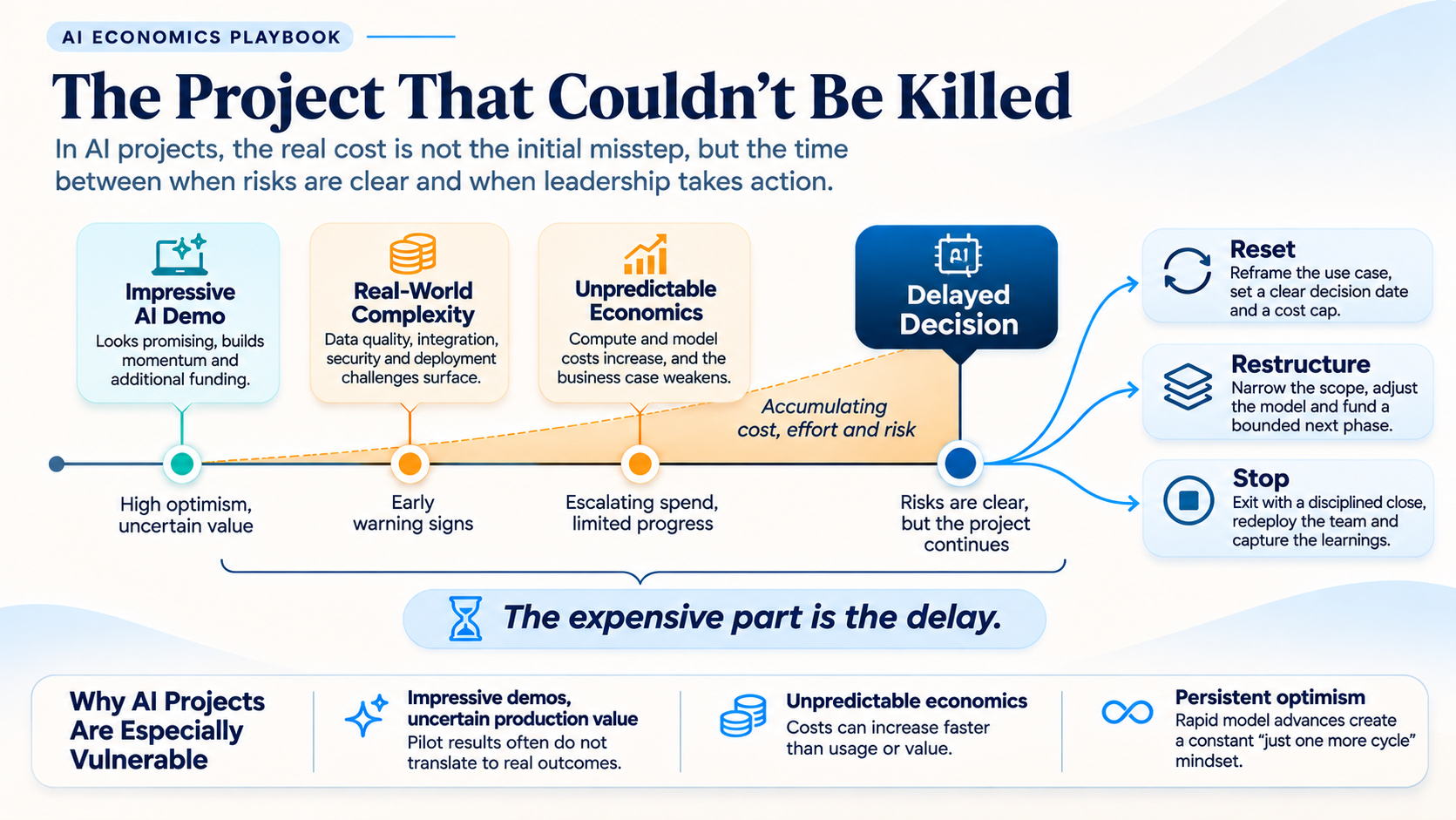 View full-size illustration (opens in a new tab)
Intervention does not always mean termination
I want to be careful about one thing, because it is where I see good leaders freeze. Intervention is not a synonym for termination. Collapsing the two is what makes stopping feel like a verdict on your judgment, and so it gets deferred. There are gentler moves that come first. You can reset - put a real decision date and a real cost cap in writing, and let the project continue on honest terms. You can restructure - take something that has quietly become an open-ended commitment and re-scope it back into a bounded bet with a defined premium and a defined expiry. Or, yes, you can stop, at the exit cost you ideally made the team quantify before you ever funded them. Three moves. Stopping is only the last of them, and it is the rarest.
The courage this takes is smaller than it feels - smaller than the courage it took to fund the thing in the first place. A finance leader who can end a bet as cleanly as they can back one is not a pessimist standing in the way of innovation. They are the reason a program's failures stay small enough for its winners to matter.
I am not propounding anything here that any of you have not felt in your own gut about some project, or some scooter, or something else. I am pretty sure I am mostly stating the already-stated (and yet might not be all the obvious !). But I have found it useful to say it out loud: the goal is not to fail less. It is to shorten the lag between knowing and admitting. Everything expensive lives in that gap.
I would genuinely love to hear how you have handled this - the project you stopped a quarter too late, or, better, the one you caught in time and what tipped you off. Always ready for a learning or two.
Thank you for reading.
Sources: the 40%-of-agentic-AI-projects-canceled-by-2027 forecast — Gartner (June 2025). The 42% abandonment figure (up from 17%) — S&P Global Market Intelligence (2025). The survey on unexpected AI costs delaying or canceling initiatives — CFO Dive (2026), on Mavvrik's State of AI Cost Governance report. The escalation-of-commitment mechanism draws on Barry Staw's foundational research and on my forthcoming book, The AI Economics Playbook.
#CFO #FinOps #EnterpriseAI #AIGovernance
Editorial note: The original 15 paragraphs and source notes are presented in their original order and wording. The summary, section headings, pull quote, key takeaways and illustration are editorial additions.